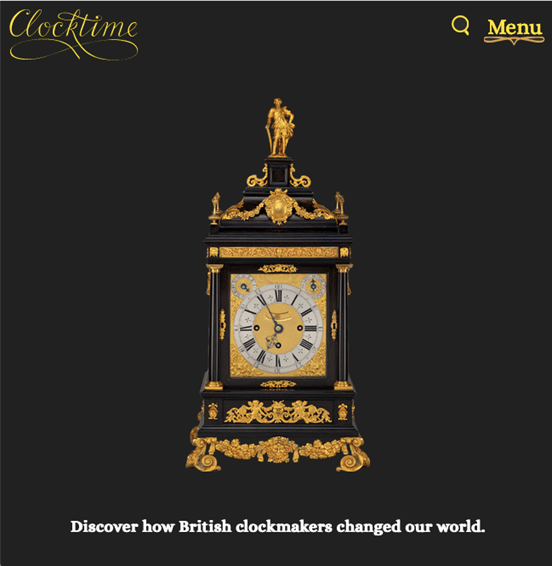
For our December 2024 event, we heard from Dr Kristin Leith FSAScot, Senior Curator of Clocktime, a new digital museum which enables a worldwide audience to discover how British clockmakers changed our world.
Kristin discussed how her team have been steadily growing their follower and engagement numbers ever since they launched their accounts in early 2024.
Behind Clocktime
Clocktime is a museum that exists only online. It showcases the impressive collection of Dr John C Taylor FSAScot, who holds over 400 patents and created the automatic thermostatic timer, which is the technology that turns off a kettle when the water has boiled.
The museum’s digital exhibition focuses on the Golden Age of British clockmaking, around AD 1600-1800. Their aim is to deliver a pioneering, world leading digital museum that inspires and excites visitors about timekeeping and clock- and watchmaking, as well as the importance of our understanding of, and relationship with, time.
Kristin oversees the curation of this digital space and actively participates in and contributes to their social media strategy. There are 10 individuals in the team, with three working on social media. The museum officially launched on 12 March 2024, which is also when their social media channels became active. Kristin describes their content as elegant, playful, informative and engaging.
Clocktime’s Social Media Strategy
The museum has a presence on Facebook, YouTube, Instagram, and LinkedIn. Their two main aims are to:
- Drive traffic to the website (exhibition), and;
- Cultivate and build an engaged Clocktime community.
The audiences that Kristin and her team have decided to cultivate as followers are:
- “Clock lovers” – this is their core horological audience comprised of clock and watch lovers, watch and clockmakers, horological educators, students, dealers, auctioneers, repairers, curators, historians/researchers/scholars, collectors, other horological collections and their staff
- The luxury watch audience – brands, makers, watchmaking schools and departments, instructors, related artisans, watchmaking students
- Professional audiences, such as those in the museum & heritage sector – this includes colleagues working at other museums, galleries, auction houses, and guilds
- Making communities – audiences interested in artisan crafts and the history of making, especially those interested and invested in British crafts and heritage, makers, and the organisations and foundations that support them
- Students and educators – focused on the study of horology and watch and clockmaking
Content
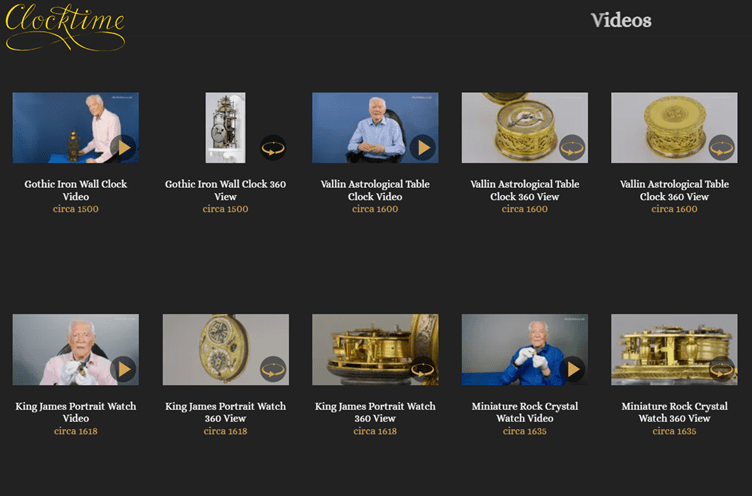
For all their social media posts, the Clocktime team have adapted video and photographic content from the digital exhibition.
For Instagram, LinkedIn and Facebook, their process was:
- Identify photo and video content from Clocktime, particularly high-quality ones created via in-house production as this makes a lot of difference to social media performance.
- Create posts that were professional and official in tone. They focused specifically on introducing Clocktime, celebrating its milestones and successes and promoting events
- Schedule the programme of posts to go out across each of the three platforms biweekly on Tuesdays and Fridays at 10am GMT.
They took this approach because:
- It was efficient – Clocktime has a very small team
- They needed to create a considered, professional profile from scratch
- It gave the team room to observe patterns that will inform how they might implement variations going forward
The team followed this pattern for their first 9 months on social media and they’ve learned a lot along the way.
The team went from 0 to 538 followers in 9 months, and it’s their most popular social platform at present. It’s been a learning process, namely because much of the video content on Clocktime is in a horizontal format, and Instagram best showcases video in a vertical format.
At least part of the reason for their popularity is that there are other horological friends on the platform, such as Rebecca Struthers, a widely respected watchmaker and champion of heritage crafts. Rebecca has a large following on Instagram and offered the team a masterclass in how to adapt short form videos to the platform, helping them to create their most successful post to date.
Rebecca generously converted a snippet from Clocktime’s existing video on the King James Portrait Watch to a vertical format and shared this video on her account. The reel made from this was the Clocktime account’s most popular to date, with 14.5K views. Clocktime also gained a noticeable bump in followers and increased activity after Rebecca’s post.
Another reason for this video’s success was choosing to focus on an artefact that’s extremely visually attractive, romantic, and which has a compelling story around it.
Going forward in 2025, Kristin and her team will be focusing on short form content, which will include a mix of clips from longer YouTube videos as well as day in the life content from the team shot on a smartphone.

The Clocktime team chose LinkedIn because it’s a pipeline to their professional audience. It’s also a great resource for building relationships with allies and friends in relevant communities and related sectors. Furthermore, it gives them a platform to introduce and hone their professional profile, thus legitimising the brand to colleagues and stakeholders. Kristin appreciates the ‘respect factor’ that a well-crafted LinkedIn presence can generate and sees it as a vital part of their community building agenda, as it’s a place where they can champion and be championed by colleagues and organisations in our communities.
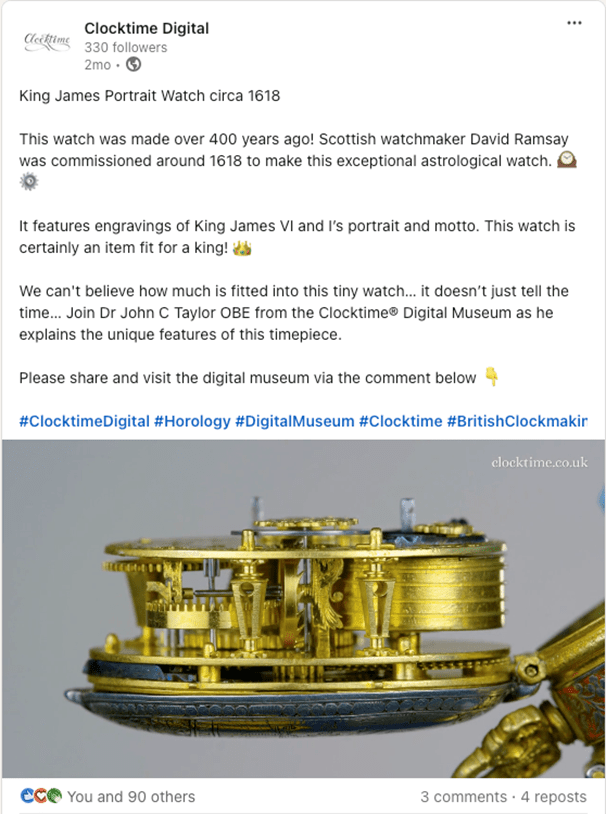
Clocktime’s LinkedIn account isn’t quite as popular as their Instagram, but it’s going well, with their follower count steadily growing. As of today, they have 360 followers, and posts are consistently engaged with to some degree. They’ve had a few successful experiments in which individuals with larger followings, like Kristin herself, have reposted Clocktime’s content or tagged them, and they’ve also increased impressions and engagement by strategically tagging friends and allies with larger followings.
Again, video content seems to have the highest engagement. Their most successful post, a Clocktime video of the King James Portrait Watch, garnered 1,010 views, 1,478 impressions, and 105 clicks. Going forward in 2025, they’ll once again focus on more short form content.
The Clocktime team chose to make a Facebook page for Clocktime because Facebook is a known quantity, and it’s easy to adapt and share posts and stories from other platforms (particularly Instagram and even LinkedIn).
This is their least successful platform, which Kristin puts down to a lack of specificity driving their Facebook approach.
Scheduled posts seem to have very little traction on Facebook and engagement is low. Followers are growing, but at a glacial pace. At the time of the SHSMG talk, they had only just recently reached 100 followers, allowing them to finally generate more detailed analytics.
In keeping with Instagram and LinkedIn, short form video content is the only type of content making any sort of impression.
Going forward, there’s much room for improvement, and Kristin says that they need to rethink their Facebook approach. In the short term, the team is thinking about changing their approach to:
- Be much more consistent about sharing stories from Instagram to Facebook
- Personalise content, introducing personalities in the team
- Tweak their scheduling: switching from twice weekly morning posts to evening postings, when people are home from work and scrolling for pleasure
YouTube
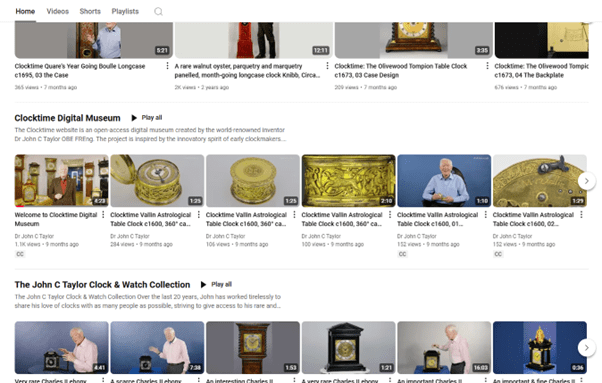
YouTube is Clocktime’s most successful platform overall. This is partly because Dr John C Taylor already had a well-established YouTube channel, which had around 1,000 subscribers at time of Clocktime’s launch.
Kristin’s team launched a Clocktime playlist in conjunction with the launch of the Clocktime website. Since March 2024, they’ve gained about 600 new subscribers which now has 1.66K subscribers.
Uploaded videos are adapted directly from the longer-form videos that are exclusive to the Clocktime website. Effectively, they’re edited snippets that have been excerpted from the Clocktime videos and been uploaded as stand-alone short videos. These are typically two to three minutes long, beautifully presented and branded with the Clocktime watermark.
Video descriptions also provide:
- A brief overview of information provided by the video
- A link to the corresponding exhibit on Clocktime
- A transcript of the video
YouTube videos were initially scheduled for release on the channel roughly every three days. They had enough content to just about get through the first year, and they’re only now beginning to run out.
In a nutshell, this approach has worked extremely well. Views range from 89 to 6,300 (with an average of 400-500 views per video).
| 114 videos have been released over the last nine months. Views range from 89 to 6.3k views |
In 2025, the team will reconvene to strategize how to continue and build on this momentum, which will probably focus on developing video content of events, in addition to the tried-and-true format of producing adapted video content from the Clocktime website.
Tracking and Analytics
The Clocktime team issues monthly analytics reports on their website and platforms. Below is a general overview of the variables that they track. Looking at these together also helps to see if and how social media activity is impacting visitor numbers and activity on Clocktime.
Kristin has found that relatively few posts correlate directly to increased engagement with the website. Instead, social media posts appear to have the greatest impact when it comes to building community and raising and maintaining awareness of Clocktime. They keep Clocktime fresh in the minds of followers who, by and large, have already visited Clocktime.
When you consider the analytics for the past nine months, a few themes emerge:
- Short form video content is popular (no surprise there)
- Community-building posts are particularly effective thanks to the art of tagging, which is a lovely symbiotic relationship as it allows Clocktime and its team to champion and be championed by colleagues and organisations in our communities
- The ‘word of mouth’ effect is indeed powerful on social media, particularly for a new museum (social media ‘shout outs’ from friends and allies really help to grow followers)
Going forward – what they’ll do differently
- Focus on production of short form video content
- Develop a more personable voice for socials
- Introduce and develop Clocktime personalities alongside official museum video content
- Cultivate mutually beneficial ‘shout outs’ on social media in a more targeted way
Kristin noted that Clocktime is, first and foremost, an educational resource, and the development of Clocktime’s educational initiative will be a key area for social media programming in 2025-2026.
This will compel the team to expand their social media strategy to cultivate a broader education audience across their platforms. This also means that they’ll likely expand their social media platform presence to TikTok, which in turn invites the production of educational short-form video-based content with a punchier, more personalised and casual vibe.
Finally, Kristin invites you to visit Clocktime Digital Museum. She recommends that you take special note of how the clocks automatically set to your local time (no matter where you are in the world). Even better, if you fancy having one the world’s most magnificent mechanical timepieces keep time for you, just click on your favourite clock or watch. If you want a larger view, click on the ‘full screen’ button below the clock. As long as the window is open, your chosen clock will keep time for you all day long. Now, everyone can experience a horological masterpiece in their home or office.
To keep abreast of Clocktime’s social media campaigns, follow the digital museum on Instagram, Linkedin, Facebook and YouTube.
For exciting news and profiles and gorgeous visuals from the world of horology, subscribe to Clocktime News. Delivered to your inbox every six weeks, it also features a column by Kristin.

 SHSMG
SHSMG 