Over the last two years, David Fettes, Social Media Manager at the National Trust for Scotland (NTS), has been responsible for the Trust’s national social media operations, as well as implementing policy and protocols for regional and departmental staff across the organisation. His policy applies to all staff at NTS and provides guidance for personal use of social media too.
He has recently been developing a social media strategy for the Trust in line with new organisational, brand and regional objectives, and in August 2024, he chatted to the group about its creation. He also offered us a framework and key takeaways that you can implement in your own strategy, with the following steps listed in chronological order.
What is a Social Media Strategy?
David explained that a social media strategy is a summary of everything you plan to do and hope to achieve on social media. It guides your actions and lets you know whether you’re succeeding or failing. The more specific the plan, the more effective it will be.
There are five components to creating a social media strategy:
- Situation analysis
- Goals
- Channels
- Tactics
- Measurement
David took us through each step one by one.
Situation Analysis
David recommended starting with a SWOT analysis of your organisation. Those are your strengths, weaknesses, opportunities, and threats.
He then advised attendees to consider internal and external factors that could impact your strategy. Such as:
- Who is your audience?
- For this, you should identify, research and listen to your target audience
- What are their demographics?
- Where are they (location/social media channel)?
- Where do they go for information?
- Where are their interests?
- What are their motivations?
- What are their pain points?
- What do they value?
You may also wish to develop audience pen portraits (also known as a customer persona) – a detailed picture of your ideal consumer, featuring the characteristics that make that reader who they are:
- What connects you?
- What content will resonate?
- What is the right approach to reach them?
- Who are your competitors?
- Where do you sit with them? Should you start benchmarking?
- How are platforms and user habits changing?
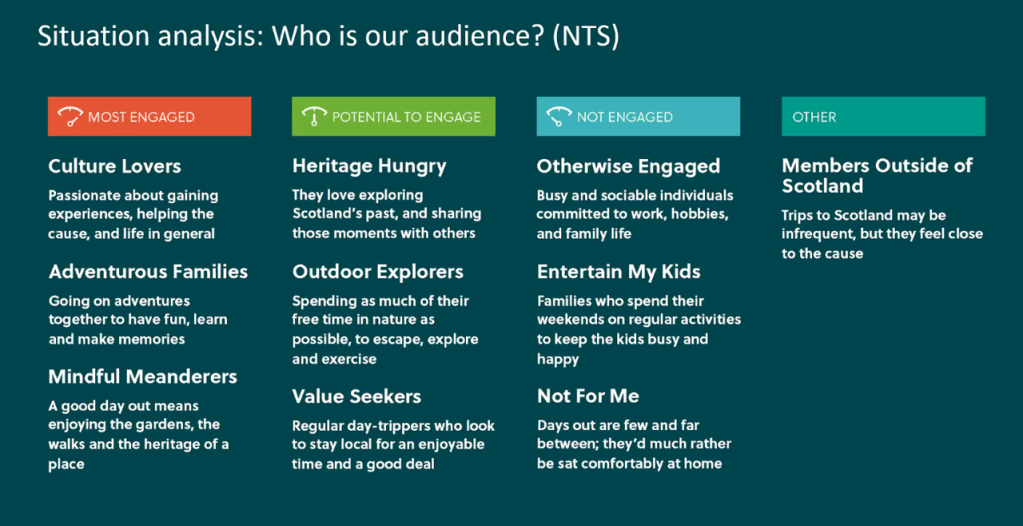
For example, here is how David categorised NTS’s audiences:
He then developed individual pen portraits from the survey data:

He also suggested tying in your own social media research from specific platforms to this wider research. What are the interests of your audience? What motivates them?
David then split NTS’s audience into segments: Culture Lovers, Adventurous Families, Outdoor Explorers, Value Seekers and the Heritage Hungry.
The audience research data suggested that the personal interests of NTS’ social media audience are history, nature, gardens, photography, architecture; their motivations are to find inspiration for visits, discovering stories; they value content that’s informative, trustworthy, accessible, inspiring and entertaining.
Goals
The next step is to decide what you want to achieve with your social media strategy.
You should align your team’s goals with your wider organisational goals. Examples may include increasing/improving:
- Awareness
- Engagement
- Traffic
- Conversion
- Sentiment
- Customer Experience
David recommended setting SMART objectives within your goals. These are objectives which are:
- Specific
- Measurable
- Achievable
- Relevant
- Time-based
For example, let’s say that your goal was to increase engagement. Your SMART objectives might break this down into:
- Specific: increase number of users that engage on social
- Measurable: 50 shares per week
- Achievable: based on previous content performance
- Relevant: shares drive higher reach, engagement and value
- Time-based: three weeks
Or perhaps your goal is to increase traffic:
- Specific: increase number of users that visit our website from social
- Measurable: 5% increase in web traffic
- Attainable: based on previous campaign performance
- Relevant: more traffic supports long-term growth
- Time-based: two months
Channels
You then need to decide what channels you’ll use to achieve these goals. Before cracking on with any or all of them, consider:
- Which current channels are/aren’t performing?
- Which new platforms could you explore?
- Which management stage is each platform at (more on that below)?
- What is the purpose of each platform?
- Do they fit with your goals?
- Which platforms are your audience using?
- What content/format works best on each platform?
David reminded us that it takes time and energy to manage a single social media platform. If sufficient resource isn’t available, then don’t have an account on a platform you’re not consistently engaging with. There could be a reputational risk from being seen as not having much to say or from not engaging with your audience.
In terms of what “management stage” a channel is at, consider whether you are maintaining, growing or revamping your channel?
For this, you need to consider whether these platforms fit with your goals? Are you looking for leads or selling products? Can you meet your audience needs on these platforms?
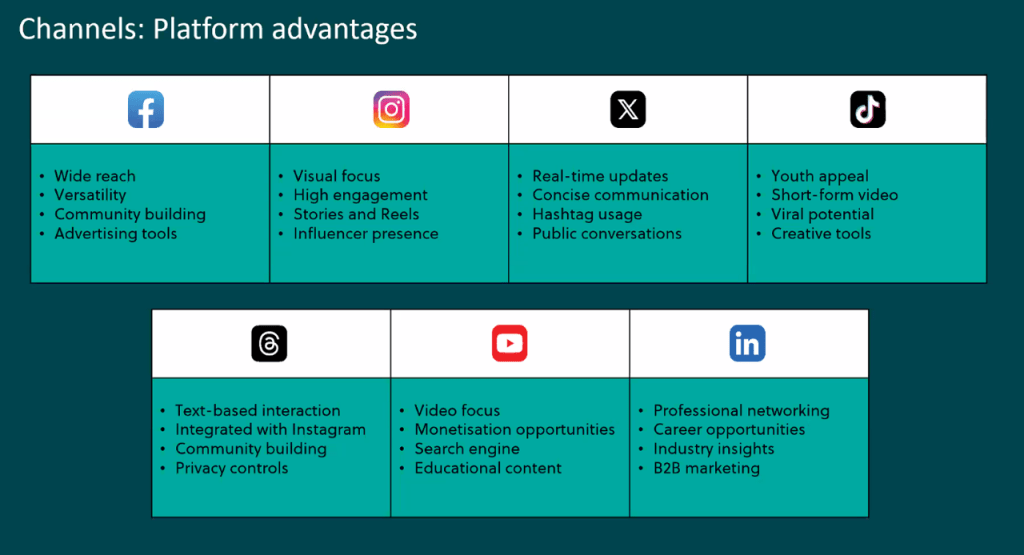
Take a look at some of the platform advantages above when you’re making your decision. Facebook, for example, has the largest user base and supports the most content types. X is a key platform for news and updates and is effective for trend tracking through hashtags. Don’t forget about YouTube – it’s the second largest search engine after Google!
Tactics
Next, David explained the need to develop a Content Value Proposition. This defines what kind of value your content provides to your audience. A Content Value Proposition helps to:
- Differentiate your social media presence
- Attract and retain followers
- Ensure your content aligns with your audience’s needs and interests
- Influence your tone of voice, channel strategies and content pillars
Ask yourself: “why should your audience engage with my content?”
- Who is your audience?
- What unique insights or information can you provide?
- What emotional or practical benefits do they gain from your content?
For example, here’s a statement about NTS that contains their Content Value Proposition:
“If you’re passionate about Scotland’s rich heritage, the National Trust for Scotland offers captivating content that showcases the very best of our country’s history, nature, and beauty. You’ll enjoy in-depth stories, cultural insights, and behind-the-scenes access that will engage, educate, and inspire you.”
This will help you create your content pillars (ways of categorising the content that you want to produce). For the NTS, these are:
- In-depth histories: property stories, famous figures, notable events
- Cultural insights: Scottish traditions, music, folklore
- Behind-the-scenes access: nature projects, gardening tips, architectural treasures
David explained that the next step is to write down your platform matrix. Basically, putting all this information together into a table. So, for the NTS, it looks like this:

Don’t forget to decide on your tone of voice, too. How do you come across (emotionally, personality-wise) given your audience and your brand and goals? Consider if you can tailor your tone to meet audience expectations. Is there a different tone for different formats?
You should define a clear tone of voice to maintain a consistent and engaging presence across social media channels:
- Determine the emotions and messages
- Understand your audience
- Consider different content types
- Create a style guide
- Monitor and adapt
For example, the NTS’s tone of voice is:
- Informative and trustworthy
- Warm and welcoming
- Inspirational and motivational
- Entertaining and light-hearted
- Professional yet accessible
What’s more, David told us that it’s important to be aware at all times of the marketing funnel, and where your social media content sits within it.
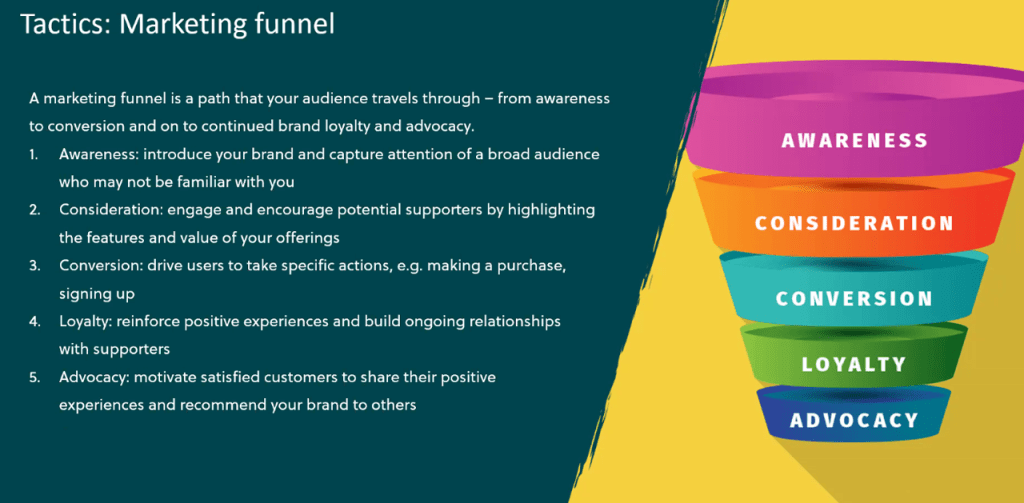
He explained that the vast majority of your content should be aimed at raising awareness and capturing attention, not pushing action (e.g. selling tickets or merch).
80-90% of your time should be spent entertaining, inspiring and educating, and 10-20% convincing and converting.
When it comes to convincing colleagues of this model, David said that he employs a social media content request form with a conversion element attached to it for colleagues to fill in when they want something advertised on social media. Some colleagues don’t bother, but if they do, it eliminates a lot of extra work for the content creation team. They can use it to decide if social media is the right format for the proposed content or if they need to put some money behind it to do some different type of marketing.
Finally in tactics, David talked about the difference between organic vs paid marketing.
He encouraged us to leverage organic content through:
- Engagement: create high-quality, engaging content that resonates with your audience and encourages interaction
- Consistency: maintain regular posting to build and sustain organic reach and engagement
- Community building: respond to engagements, create a dialogue, and foster community
And to utilise paid content for:
- Visibility boosting: use paid ads to amplify high-performing organic posts, reach new audiences, and promote specific campaigns or events
- Targeted ads: leverage advanced targeting options to reach specific demographics and interests relevant to your goals
- Testing and optimisations: run A/B tests to identify which ads perform best and adjust your strategy based on performance data
Measurement
Measurement is crucial to your strategy.
To do this effectively, you should figure out your Key Performance Indicators (KPIs) and metrics.
KPIs are strategic and aligned with business objectives, and provide a measure of success towards achieving those objectives
Metrics are individual data points that provide detailed insights into specific aspects of performance, but they don’t directly indicate success on their own.
KPIs are important for:
- Performance measurement
- Goal alignment
- Data-driven decisions
- To demonstrate Return on Investment (ROI)
- Continuous improvement
For example, if your goal is to improve brand awareness, your KPI would be the number of users reached by social media activities. The metrics you use to track this could be reach, impressions, video views, followers and/or follower growth rate.
If your goal is to increase audience engagement, your KPI would be the number of users engaging with social media activities. The metrics needed might be reactions, clicks, comments, shares and/or engagement rate.
When you’re measuring your performance, be sure to create reports that encourage action and drive reporting. These might include visualisations such as charts and graphs for easy understanding and insights to highlight top performing trends and anomalies. Context is also important, so be sure to compare previous performance and include influential activities. And don’t forget recommendations: provide specific actions and strategies for improvement and testing ideas.
In terms of reporting, David believes you should be doing this “kind of all the time”. He recommends weekly reporting to track short-term performance and to make quick adjustments, monthly reporting to assess overall progress and make strategic adjustments, and quarterly reporting to evaluate long-term trends and make significant strategic decisions.
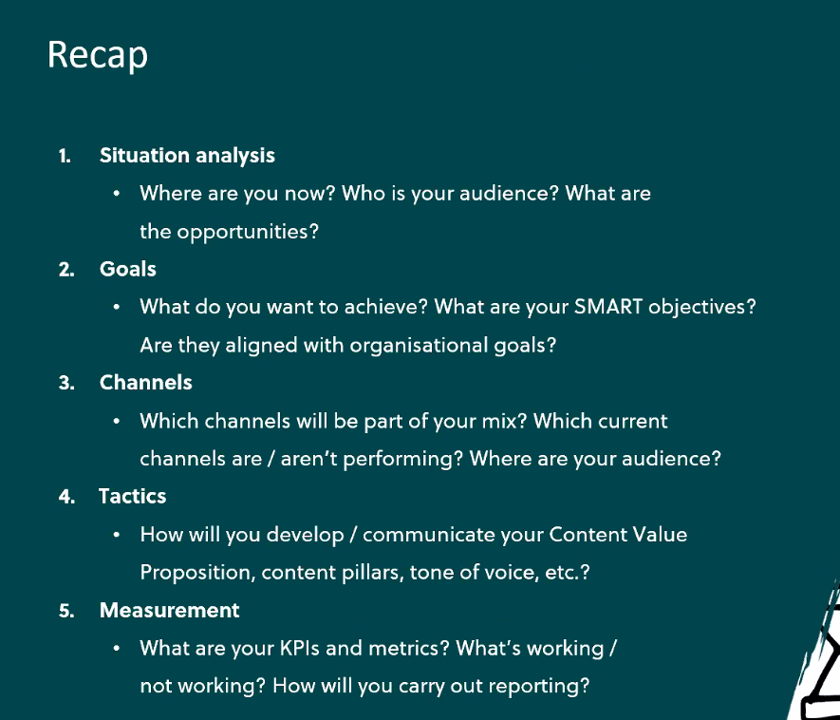
And that’s it! These five steps engage audience and drive meaningful results for your organisation, so it’s essential that you develop these into your social media strategy.
As David said:
“Be brave about your choices and good luck!”
Be sure to follow National Trust for Scotland’s accounts on Facebook, Instagram and X, and connect with David on LinkedIn.

 SHSMG
SHSMG 