What exactly is Black History Month? Why is it important to create social media content for it (even if you’re not running any events or don’t have anything new to share)? And how can content creators avoid tokenism with their social media posts?
The Coalition for Racial Equality and Rights (CRER) coordinates the programme of events for Black History Month in Scotland every October. For our June 2024 event, Amy Rich, CRER’s Communities and Campaigns Officer, shared her insights on how you can get involved.
WHAT IS THE COALITION FOR RACIAL EQUALITY AND RIGHTS (CRER)?
Amy began by telling us about CRER, which is a Scottish strategic anti-racist organisation.
Their mission is to protect, enhance and promote the rights of Black and minority ethnic communities across all areas of life in Scotland and to strengthen the social, economic and political capital of Black and minority ethnic communities, especially those at greatest risk of disadvantage.
They do this work in a number of different ways, including by engaging with public sector organisations to mainstream race equality in all aspects of their work.
They also have a focus on Black history in Scotland as the contributions of African, Caribbean and Asian people in Scottish history are often forgotten about or relegated to a bit part.
Black history is a part of Scotland’s history, and CRER undertake efforts to change this narrative by coordinating the Black History Month programme of events in Scotland every October (which attracts around 4,500 users to their website each October).
THE HISTORY OF BLACK HISTORY MONTH IN SCOTLAND
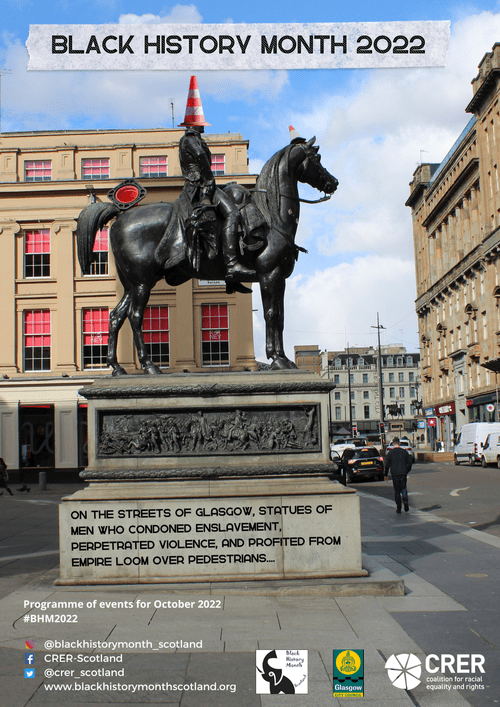
The concept of Black History Month came from the son of former enslaved people, Dr. Carter G Woodson, an African American scholar, who noted that American history books largely ignored the Black American Population.
The first UK Black History Month was launched in October 1987 by the Greater London Council thanks to the efforts of Ethnic Minorities Unit staff Ansel Wong and Akyaaba Addai-Sebo, along with Cllr. Linda Bellos, Cllr. Narendra Makanji and Deputy Leader of Education, Bernard Wiltshire.
In Scotland, CRER has coordinated a uniquely Scottish Black History Month during October since 2001. This encompasses the history of African, Caribbean and Asian people in this country; people who often have a direct link with Scotland through slavery, colonialism and migration. Black History Month focuses on people whose sacrifices, contributions and achievements against a backdrop of racism, inequality and injustice are often forgotten about.
Each year, they coordinate the programme in collaboration with a huge number of organisations. Events take place online and in-person and include walking tours, exhibitions, talks, workshops, panel discussions, film screenings and more.
WHY CREATE SOCIAL MEDIA CONTENT FOR BLACK HISTORY MONTH?
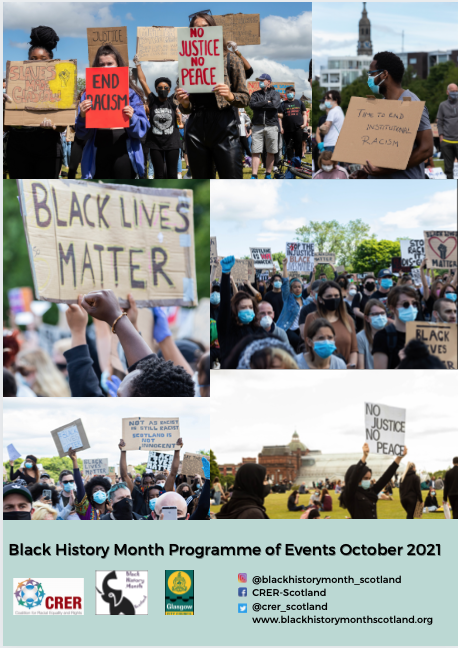
Living in the wake of the murder of George Floyd and the Black Lives Matter movement in 2020, Amy believes that many of us already know about the ways in which racism is a structuring force in modern society in Scotland.
Nevertheless, it’s worth checking out CRER’s “Ten Things We Need to Say about Racism” resource which outlines some of the ways in which Black and minority ethnic people are still being structurally and personally affected by this system of racism in Scotland.
This includes the fact that:
- Over 1 in 3 people from a minority ethnic background are trapped in deep or very deep poverty
- Racial hate crimes remain the most commonly reported hate crimes in Scotland
- Research has highlighted the existence of both subtle everyday racism and overt racism in schools impacting Black and minority ethnic peoples
One of the items on the list also notes that slavery was instrumental to Scotland’s economic development. We know that Scotland played an oversized role in the transatlantic slavery trade and in reaping the financial benefits of enslaved African labour in places like the Caribbean and America through the “compensation scheme”.
After slavery was abolished in 1833, the British government decided that those who had been worst affected by abolition – in their opinion, the enslavers – should be compensated. The compensation scheme was introduced to compensate people for their “loss of property”. The British government took out a loan of 20 million pounds to finance it – equivalent to around 11 billion pounds in today’s money – which was paid out to those involved in slavery at the time of abolition.
Across Scotland, the compensation scheme can be broken down per person per capita in terms of the money that different places got from the scheme. The city that benefited the most was Edinburgh, followed by London, then Glasgow.
This means that there was a huge overrepresentation of Scottish people receiving money from this compensation scheme, and that money was often invested back into the infrastructure around us. It also funded further investment into industry, housing and buildings across the country.
Interestingly, the compensation scheme can be linked to the Highland Clearances as well, which was the forced removal of people from the Western Isles and the Highlands of Scotland. Between a third and a half of the people involved in enacting the Clearances who owned that land had some sort of tie to the slavery compensation scheme.
An example of this is a man named Colonel John Gordon of Cluny who was compensated an equivalent of around one million pounds into today’s money. He then went on to displace around 3,000 people in the Highland Clearances using some of the money he received from the scheme.
Amy stressed that we’re still facing the consequences of these ties and we’re still very much living in a world shaped by these legacies of slavery and empire.
We also know that, according to new data published earlier in 2024, around 7% of Scotland’s population comes from a Black or minority ethnic background. This is a huge number of people that are being systematically left out of narratives. This is an audience that should be considered and catered to when we’re thinking about how we tell the story of Scotland. CRER wants to see a more accurate view of Scotland’s history that doesn’t exclude the contributions and sacrifices of these communities.
Alongside that Black or minority ethnic background audience, there’s also a need for Black history to be brought into the mainstream; to audiences that might not already be aware of Scotland’s connections to slavery and empire.
Amy also highlighted the Empire, Slavery & Scotland’s Museums project, sponsored by the Scottish Government. In 2021 and 2022, a national consultation was held to establish public and expert perspectives on how museums can contribute to our understanding of the legacies of empire, colonialism, and historic slavery. As a result of this project, and based on the evidence gathered, the project Steering Group made six recommendations to the Scottish Government, two of which seem particularly pertinent to Amy:
- Museums should ensure anti-racism is embedded in their workplaces
- Museums should commit to research, interpret, and share the histories of Scotland’s links to empire, colonialism, and historic slavery and public spaces
Through consultation work, they found that people want museums to share more narratives about and from communities that are experiencing the impact of these legacies of empire and historic slavery. There is demand and Black History Month is a great place to start if you’re looking to raise awareness and share stories of Black history.
Amy also shared an anecdote about a friend who works for a community-based organisation which runs a homework club for kids. Her friend told her that some of the kids in her club were talking about how much they’re looking forward to Black History Month at their school because their history classes are always interesting, and they feel like they’re learning about history and subjects that are relevant to them. To Amy, this was a stark reminder about the importance of Black History Month.
RESOURCES FOR CREATING SOCIAL MEDIA CONTENT FOR BLACK HISTORY MONTH
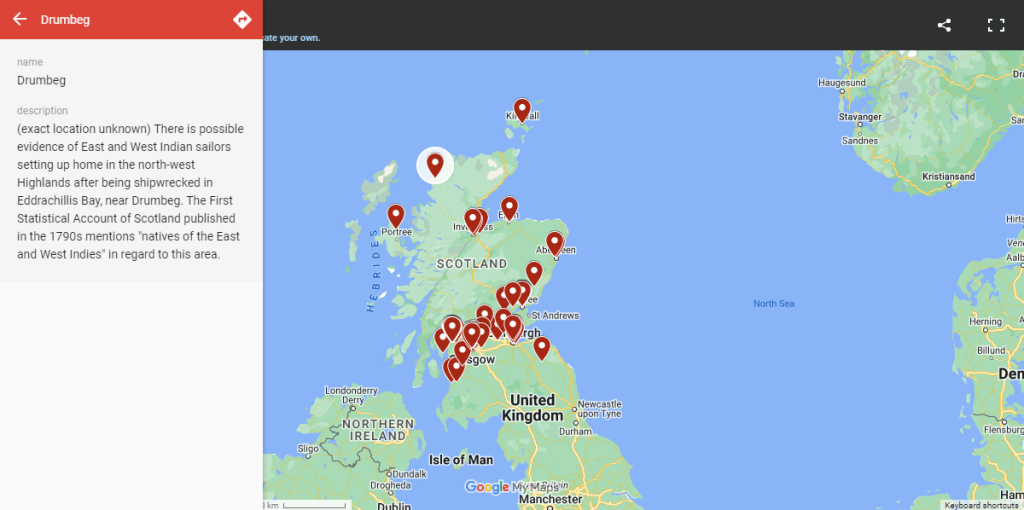
If you’re ready to get started, Amy recommended using the Black History Map on their Black History Month website (pictured below). It’s an interactive map which enables you to click on pinpoints which open to reveal information about that location. The map is the beginnings of work to trace some of the history of African, Caribbean and Asian people in Scotland and their connections to Scotland.
Through this map, CRER want to show a more accurate view of Scottish history and to counter the narrative that Black people have only been in Scotland due to recent migration patterns and that these histories are only present in big cities like Glasgow and Edinburgh, neither of which are true.
The Black History Month website also hosts an archive of old Black History Month programs which are a rich source of information, including historical stories that have been told but don’t often get repeated.
She also recommends looking at Dr Stephen Mullen’s work at the University of Glasgow and Historic Environment Scotland’s report on the connections between their Properties in Care and the British Empire.
Amy also highlighted the University College London’s Legacies of British Slavery database as a useful tool for tracing the paper trail that’s been left by the compensation scheme. It outlines everyone who was paid off as part of the scheme and you can search geographically or for specific names.
If you’re looking to commission (paid) content or pass the mic, Amy recommends the Beniba Centre for Slavery Studies at the University of Glasgow and the academics who are attached to that work, as well as Pass the Mic, who are a resources to find Black and minority ethnic women experts on different subjects.
You could also reach out to smaller Black and minority ethnic community groups across Scotland who sometimes do work into Black history and could help you find those local connections, collaborate on telling stories and putting on events that speak to local communities.
TIPS FOR CREATING SOCIAL MEDIA CONTENT FOR BLACK HISTORY MONTH
If you’re worried about telling these stories when you’re not part of a minority ethnic group, don’t be – it’s not cultural appropriation. Folks in social media roles often tell the stories of people who they have no connections to. The important thing is to not claim ownership over the stories, to not try to speak for anyone else and to not use it as a way to generate profit (similar to “greenwashing” or “pinkwashing”).
Amy also advised content creators to keep stories local. This ensures that the information feels relevant to audiences, and it helps to foster that sense of connection between our communities, the environment around us and to our shared histories.
According to Amy, it’s also important to avoid a self-congratulatory tone and to acknowledge the reality of the racism that we’re still living with today. For example, it would be problematic or tokenistic to post something along the lines of “the British abolished slavery” without referencing the many hundreds of years that they benefited from and perpetuated slavery. Another example would be to post about James McCune Smith, the first African American to earn a medical degree (which was awarded by the University of Glasgow), without acknowledging the racism experienced on campus today.
And remember that Black history is not limited to just slavery and empire. Black people have been living in what is now Scotland for hundreds, if not thousands, of years, and all across the country. For example, you could post about the Black football players that have played for Scottish teams (like Andrew Watson) or the British Honduran Forestry Unit, a civilian body of forestry workers who came from British Honduras to Scotland to help support the war effort during the Second World War.
Amy also reminded us that it’s okay to share content from previous years and that you don’t need to be running an event or conducting new research to post about Black history during Black History Month. You may already have relevant resources that can be repackaged.
Historic Environment Scotland, for example, tweeted/posted about Lisa Williams’s blog post on taxidermist John Edmonstone in 2021, 2022 and 2023, while the Glasgow School of Art Library created a Black History Month playlist in 2023 using existing videos/resources.
Amy also noted that Black history content shouldn’t be limited to one month of the year. Stories about Black lives are still largely absent from our history books, education systems, and museums and heritage organisations. However, she acknowledged that Black History Month acts as an important focal point, campaigning tool, and an entry way for many people into fostering new collaborations and new communities.
If you want to find out more about Black History Month, visit CRER’s website, subscribe to their e-newsletter and follow them on Facebook, X (Twitter), Instagram and LinkedIn. If you’ve done any work on Black history in Scotland, you can also send your resources to Amy to be included in their map. Finally, if you’re planning on submitting an event, the deadline for the 2024 programme is 19 July.
Header Image Credit: Malini Chakrabarty

 SHSMG
SHSMG 